
Turkish Wedding Traditions in Cappadocia
From henna nights to gold pinning, Turkish wedding traditions are rich and meaningful. Here is what to expect.

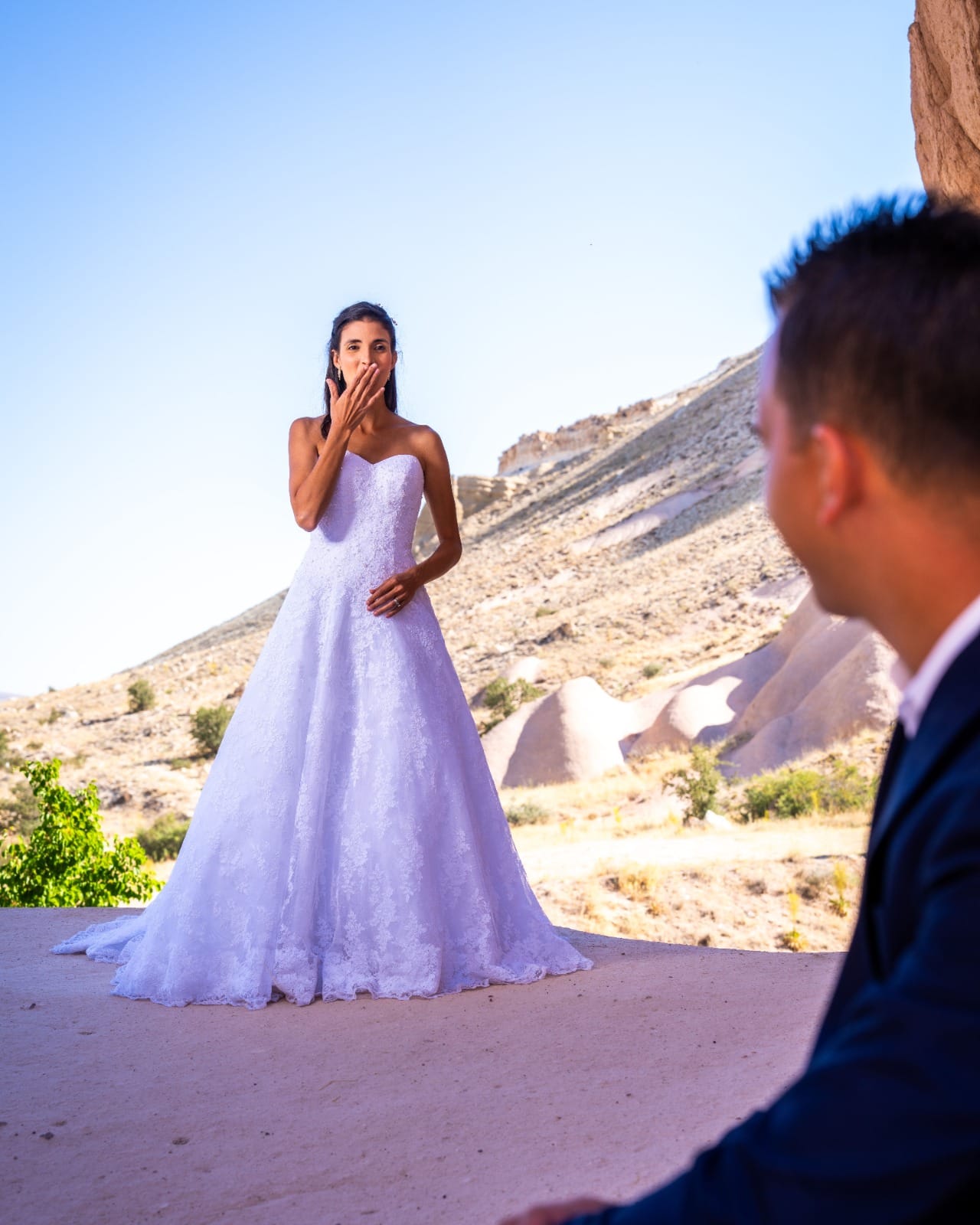
Every time we photograph a wedding, we notice the same thing: the most touching frames do not come from posed moments, but from the moments when traditions are lived. A mother crying as she places henna on her daughter's hand. The groom caught laughing with his friends. The quiet walk where the bride is given away by her father. These are the moments that turn a wedding from an "event" into a "story."
In recent years, there has been a clear increase in international couples wanting to incorporate Turkish traditions into their Cappadocia weddings. Some are of Turkish heritage and want to honour their own culture. Some want to reflect their connection to Turkey in their wedding. Others simply find a tradition beautiful and want to adapt it for their own day. All are valid.
Henna Night (Kina Gecesi)
Perhaps the best known and most emotional of all Turkish wedding traditions. The henna night is traditionally held the evening before the wedding. It is a farewell ritual among women, attended by the bride's family and closest friends.
How it works: The bride covers her head with a red veil. Her hands are held open, palms facing up. Her grandmother or mother places henna in her palm. By tradition, the bride should cry — it represents the sorrow of leaving the family home. If she does not cry, gold is placed in her hand until she does. Music plays, the women sing, and then henna is applied to everyone's hands in turn.
The Cappadocia adaptation: It is entirely possible to hold an intimate henna night in a cave hotel suite or on a terrace. A grand hall is not required — in fact, smaller spaces create a more emotional atmosphere. Candles, red fabrics, traditional music, and a group of 10-15 people. That is all it takes.
From a photography perspective, henna night is a goldmine. Low light, candle flames illuminating faces, intense emotions — powerful frames emerge. We generally shoot henna nights in a documentary style, capturing moments without intervening.

Tip: You do not have to hold the henna night the evening before the wedding. Some couples do a short henna ritual on the wedding day afternoon, as part of the preparation process. Fifteen to twenty minutes, with only the closest people. The timing is up to you.
Groom's Shave
A lesser-known but highly photogenic tradition. On the morning of the wedding, the groom has a traditional shave with a straight razor, performed by a barber, in the company of his close male friends and his father. During this time, friends joke around, share anecdotes, and sometimes give emotional speeches.
How it works in Cappadocia: There are traditional barbershops in Goreme and Urgup. Some couples bring the barber to the hotel. In a suite or on a terrace, after the morning breakfast, as the first step of wedding preparations.
This ritual usually takes 30-45 minutes and adds a wonderful rhythm to the groom's preparation process. While hair and makeup are happening on the bride's side, something meaningful is also taking place on the groom's side.
Note: International couples love the groom's shave tradition too. It pairs naturally with groomsmen culture. Think of it as the final "preparation moment" spent with your friends before the wedding.
Bride Pick-Up (Gelin Alma)
In traditional Turkish weddings, the groom comes to collect the bride from her home. Obstacles are placed at the door — money is demanded, songs must be sung, dances must be performed. The bride's family symbolically conveys the message: "We will not give our daughter away easily." Although it sounds like a serious custom, it is actually a very fun and joyful process.
The Cappadocia version: A hotel room or suite door becomes the "bride's home." The groom and his groomsmen arrive at the door; the bride's friends or family refuse to open it. Negotiation begins. Small envelopes, jokes, sometimes little challenges — eventually the door opens and the groom sees the bride.
Even a shortened version of the bride pick-up ritual works beautifully at destination weddings. A 10-15 minute version produces both entertaining and emotional frames. It increases guest participation and gives the wedding day an energetic start.
Wedding Favours and Sugared Almonds
At Turkish weddings, guests receive wedding favours typically consisting of sugar-coated almonds. Five almonds represent: health, happiness, long life, fertility, and prosperity. They are placed in small tulle pouches or boxes and offered to each guest.
At Cappadocia weddings, enriching this tradition with local touches makes for a lovely detail. Small ceramic boxes from local potters, locally dried fruits, or Turkish delight made with Cappadocia's grape molasses — gifts that go beyond the standard wedding favour and give guests a taste of the region.
Traditions do not lengthen a wedding — they deepen it. Each ritual adds another layer to the celebration.
Gold-Pinning Ceremony (Taki Toreni)
Perhaps the Turkish tradition that surprises foreign guests the most. After the ceremony or during the meal, guests come forward one by one to present gold jewellery or money to the bride (and sometimes the groom). A red ribbon is stretched across the bride, and gifts are pinned onto it.
How it works: A host or family elder reads out names. Each guest comes forward, congratulates the couple, pins their gift, and has a photograph taken. At large Turkish weddings, this ceremony can last more than an hour.
Intimate wedding version: When guest numbers are small (20-40 people), the gold-pinning ceremony becomes much shorter and more personal. Each guest has an individual moment with the couple. From a photography standpoint, it is wonderful — each pinning moment is a separate frame, a separate expression.
International couples adapt this tradition in different ways. Some give symbolic gifts from their own culture instead of gold. Some write wishes instead of pinning gifts. Preserving the intention — each guest sharing a one-on-one moment with the couple — matters more than the format.
Wedding Feast and Turkish Cuisine
Planning the wedding dinner around local cuisine in Cappadocia is both practical and impressive. The region has its own distinctive flavours, and most venues can incorporate them into a wedding menu.
Pottery kebab (testi kebabi) has become almost a wedding menu classic. The breaking of the clay pot at the table is both a visual spectacle and a ritual. Guests love it, and it creates a perfect moment for photographs.
Meze and sharing plates work beautifully at intimate weddings instead of individual service. Hummus, ezme, sarma, and cheese boards lined along a long table — everyone sharing, talking, reaching across. A family dinner atmosphere.
Turkish coffee served after the meal is both tradition and experience. In copper pots, in small cups — some venues even offer tableside coffee-making service. It also provides beautiful details for photography.
Then there are options unique to Cappadocia. Grape molasses, local wines (the region has several boutique wine producers), and dried fruit platters. Making the entire menu local is a strong choice for destination weddings — your guests have already travelled this far, so giving them a taste of the region is both respectful and practical.

Do I Have to Include All of These Traditions?
Absolutely not. The beauty of these traditions is that you can take as many or as few as you like and adapt them for your wedding. You can do a henna night and a gold-pinning ceremony and skip the rest. You can add only the groom's shave ritual. You can do none of them and create your own entirely new traditions.
In our experience, the best result comes when the couple chooses two or three traditions that truly feel meaningful to them and dedicates time and care to each. Trying to squeeze in every tradition makes the schedule exhausting, and you cannot fully savour any of them.
We frequently work with couples who blend traditions from two cultures, especially at international weddings. Indian henna tradition combined with Turkish henna, Japanese tea ceremony combined with Turkish coffee, Italian tarantella combined with Turkish halay — these combinations make a wedding genuinely unique.
Important: If you want to include traditions, inform your wedding planner and photographer in advance. Every ritual has different requirements for duration, lighting, and space. We adjust our shooting plan accordingly — so that no moment is missed.
Halay and Wedding Dances
The most energetic part of a Turkish wedding. Halay is a traditional group dance performed hand in hand. Accompanied by drum and zurna, the most experienced dancer typically leads from the front and guides the group.
At Cappadocia weddings, halay usually begins after the meal. On the terrace at outdoor weddings, in an open area at cave venues. The music can be professional — some couples bring in a drum-and-zurna ensemble through our live music service. Others use a playlist. Both work, but the energy of a live drum is something else entirely.
International guests love halay. The steps are simple, easy to learn, and the energy of doing it together completely breaks down any language barrier. From a photography perspective: movement, laughter, sweat, energy. The album's most vibrant pages are usually made up of halay frames.
If you have a dance tradition from your own culture too — Irish folk dance, Greek sirtaki, Indian bhangra — performing it before or after the halay creates a wonderful transition. Two cultures, two dances, one celebration.
Traditions Through the Lens of Photography and Video
As photographers, we have concrete reasons for loving Turkish wedding traditions:
Henna night — low light, intense emotion, close-up frames. The most powerful moments of documentary photography emerge here.
Groom's shave — intimate frames of male friendship. The "groom's side" stories, often missing from wedding albums, are filled in by this ritual.
Bride pick-up — energy, laughter, unexpected moments. The exact opposite of planned poses — chaotic, lively, real.
Gold-pinning ceremony — each guest's one-on-one moment with the couple. Individual portraits and emotional reactions for the album.
Pottery kebab — a micro event, repeated at every table. Surprise, laughter, applause — very lively frames.
To capture these moments properly, we need to know about them in advance. When you share which traditions you will include, their order, and approximate timing, we build our shooting plan around them. We covered the topic of creating a day schedule alongside the legal process in detail in our wedding ceremony guide.
Where to Get Information
The most accurate source of information about traditions is your families. Every family and every region has its own version — a general definition of "Turkish wedding tradition" may not exactly reflect any single family's customs. Talk to your family and ask which traditions are important to them.
Working with a Cappadocia wedding organiser during the planning process makes everything easier. Local vendors, venue compatibility with traditions, timing — you need someone to coordinate it all. As photographers, we handle the shooting side, but we can connect you with organisers we trust.
Our intimate wedding planning guide offers more detail on how to integrate traditions into smaller-scale weddings. For larger-scale planning, see our destination wedding guide.
We are not Turkish — can we still include Turkish traditions in our wedding?
Of course. Many international couples adapt Turkish traditions for their own weddings. What matters is approaching with respect and preserving the spirit of the tradition. Working with a local organiser is very helpful in this regard.
Is henna night only for women?
Traditionally yes, but mixed henna nights have become widespread in modern weddings. Especially at destination weddings where guest numbers are limited, inclusive versions are preferred.
How long does the gold-pinning ceremony take?
It depends on guest numbers. With 20 guests, 15-20 minutes; with 50 guests, 30-40 minutes. Giving each guest sufficient time is important — it should not be rushed.
How much do these traditions affect the wedding budget?
Most traditions require no additional costs. A few accessories for henna night (henna, candles, red fabric), a barber fee for the groom's shave. The real cost usually lies in organisation and timing — whether additional decor or venue hire is needed.
Can we include the traditions in our photo/video coverage?
Absolutely, and in fact we recommend it. Just let us know in advance which traditions you will be doing. We prepare the shooting plan accordingly — including additional equipment, lighting setup, and positioning.
Explore Related Experiences

Your story begins in Cappadocia
We'll craft something timeless—quiet, elegant, and cinematic.
Explore Experiences