
Sunset Ceremony: The Golden Hour Wedding
Golden hour light bathes Cappadocia in warm amber tones. Here is how to time your ceremony for that magic window.

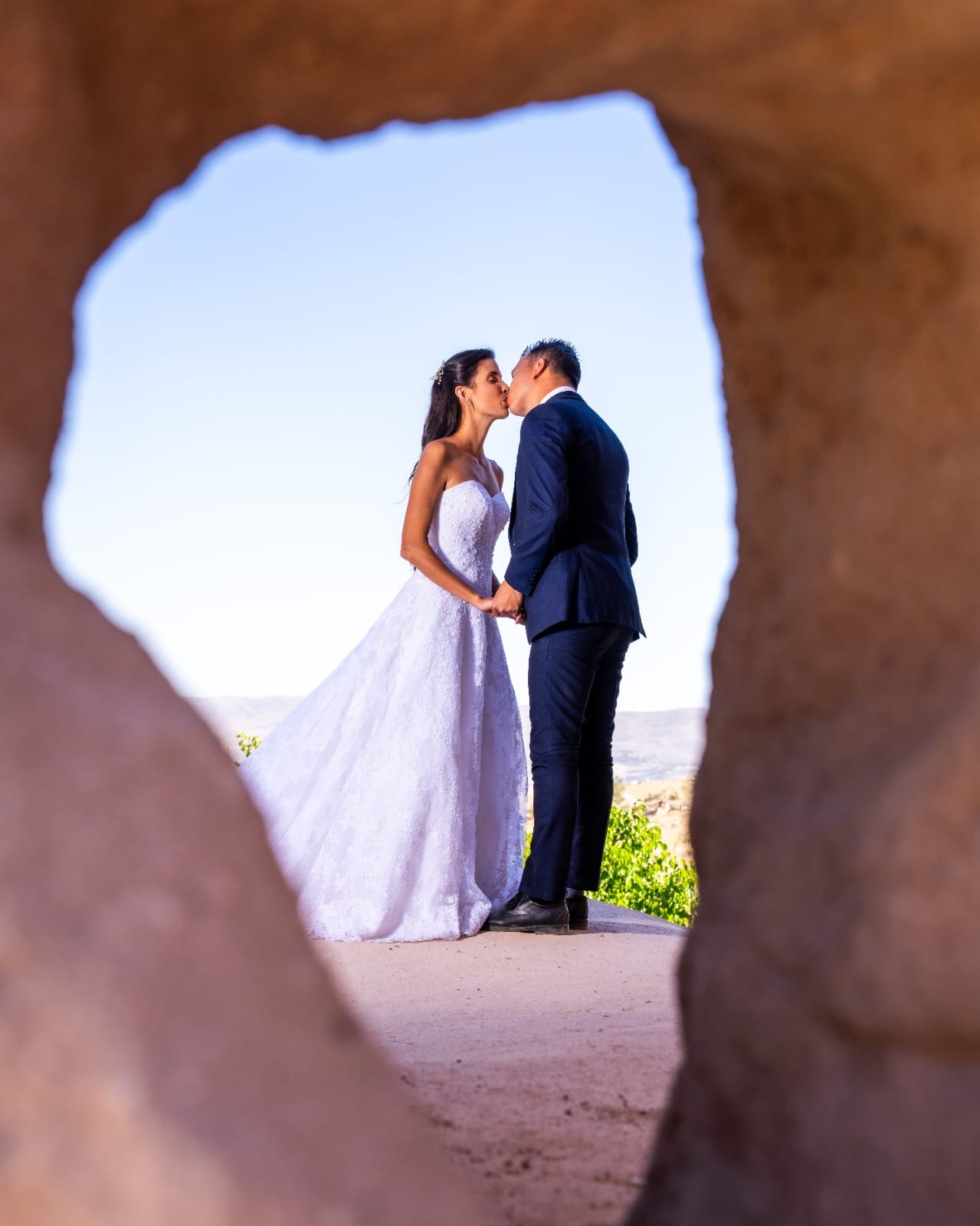
In Cappadocia, sunrise belongs to the balloons, but sunset is something else entirely. As the sun descends, the valleys turn orange and pink, the fairy chimneys cast long shadows, and the air softens all at once. A ceremony held in this light carries an atmosphere that no other time of day can replicate.
We photograph sunset ceremonies often, and every time we notice the same thing: people look different in this light. Warmer, softer, more real. As photographers, we achieve the most beautiful results with the least intervention.
What Is Golden Hour and Why Is It So Good?
Golden hour is the period when the sun is close to the horizon. It begins roughly one hour before sunset and continues until about 15-20 minutes after the sun dips below the horizon. During this window, the light has three qualities: it arrives at a low angle (falling softly on faces), it carries a warm tone (orange-gold), and its intensity is low (no squinting required).
The practical result: portraits taken during golden hour have soft shadows, warm skin tones, and a colourful backdrop. We can work entirely with natural light, without flash or reflectors.
The counterpart to golden hour is blue hour, which begins right after the sun sets. The sky turns deep blue and violet, and the atmosphere becomes more dramatic. It is possible to capture both in a single evening — the ceremony in golden hour, portraits extending into blue hour.
Tip: Golden hour lasts roughly 45-60 minutes, but the most intense light falls in the final 20-25 minutes. If you want to align the ceremony with this window, schedule it to begin 30-40 minutes before the official sunset time. This way, the ceremony takes place in full golden light, and you still have 15-20 minutes left for portrait shooting after it ends.
Timing by Season
Sunset times in Cappadocia shift significantly with the seasons:
Summer (June-August) — Sunset falls between 19:30-20:15. Golden hour begins around 18:30. The air is warm but cools towards evening. The long day adds flexibility to your schedule. The only drawback: guests should be prepared for a late dinner.
Spring/Autumn (April-May, September-October) — Sunset falls between 18:00-19:00. This is our favourite period. Golden hour light lasts longer, the weather is neither hot nor cold, and the colour range is richer. September is particularly beautiful — with fewer dust particles in the air, the golden light is exceptionally clear.
Winter (November-March) — Sunset falls between 16:30-17:30. The early sunset narrows the schedule, but the winter sun sits at a very low angle, which actually extends golden hour. Be prepared for the cold — a shawl, jacket, or heaters may be necessary.

Best Sunset Locations
Not every spot works for a sunset ceremony. Points facing west or southwest receive the sun directly; east-facing locations end up backlit. The locations that yield the best results in our shoots:
Red Valley (Kizilcukur) — Arguably the finest sunset spot in all of Cappadocia. The red rock formations glow with the sunlight. It is possible to set up a small ceremony area at the valley's edge. We covered the details in our Red Valley guide.
Cave hotel terraces — West-facing terraces are extraordinary at sunset. Guests stay in the same venue, no transfers needed, and decor preparation is easy. The most practical option.
Uchisar Castle surroundings — A wide panorama from an elevated point. A 360-degree view as the sun sets over the valley. It can be windy.
Old town Goreme — The last light filtering between stone buildings creates a warm atmosphere in the narrow streets. A lovely alternative for intimate weddings.
When choosing a location, wind matters as much as light direction. Valley edges catch the evening breeze. Long veils and light fabrics look beautiful in the wind, but candles may blow out. Factor this into your decor planning.
Ceremony Planning
A sunset ceremony should be kept short. Golden hour does not wait, and the light changes minute by minute. A 15-20 minute ceremony is ideal — vows, ring exchange, the kiss, and congratulations.
Rather than extending the ceremony itself, make the most of the time before and after. Before the ceremony: guests settle in, music plays, the atmosphere builds. After the ceremony: couple portraits immediately, in the remaining golden light.
Golden hour light gives faces a warmth that no editing software can replicate. Everyone looks beautiful in this light.
You will be choosing between cave hotel terraces, valley edges, and old town streets. Our sunset photography package is planned to work at all of these locations.
Ceremony orientation matters too. We recommend positioning the couple with their backs to the sun, while guests face towards it. This way the couple's faces are lit by golden light, and the valley landscape appears in the background of your photographs. In the reverse arrangement, the couple's faces fall into shadow.
If you are building a wedding day timeline, place the sunset ceremony at the centre and arrange everything else around it. The sunset time does not change — you adapt to it.
Photography and Decor Tips
Keep decor minimal. The sunset light and the Cappadocia landscape already do all the work. Large floral arches or heavy decor elements block the view. Low arrangements, a few clusters of candles, and chairs — that is all you need.
Use candles carefully. Wind will extinguish candles in an open setting. Candles in glass hurricane holders are both wind-resistant and photogenic. Choose strategic placements rather than increasing the number of candles.
Clothing colour interacts with golden hour light. White and cream tones pick up a warm golden reflection — this looks beautiful. Very dark colours (a black suit) can lose detail. With dark tones, it is wise to do a test shoot with your photographer beforehand.
Consider a second photographer. A sunset ceremony cannot be captured from a single angle. Sun direction, guest perspective, and wide shots — multiple viewpoints are essential. Two photographers capture this moment far more comprehensively.

After the Ceremony: Blue Hour
It does not end when the sun goes down. Blue hour — 15-30 minutes after sunset — is when the sky turns deep blue and violet. Portraits taken in this light are dramatic and striking.
We usually set aside 10-15 minutes at the end of the ceremony for a blue hour shoot with the couple. Guests move to the cocktail area in the meantime. The result: a golden hour ceremony plus blue hour portraits — two different atmospheres in a single evening, and a richer album.
What if it is cloudy?
On cloudy days there is no golden hour as such, but light breaking through the clouds can be dramatic in its own right. Even in fully overcast conditions, there is still a soft, diffused light at sunset time — still very suitable for portraits.
Do we need special permission for a sunset ceremony?
Not if you are at a venue or hotel. For public areas (valley edge, park), you may need to speak with local authorities. Your planner will manage this process.
Do guests have to face the sun?
No, we can adjust the seating arrangement so that guests are positioned at an angle to the sun. Having them face the sun directly does not cause discomfort — the sun's intensity is low during golden hour. But you might suggest sunglasses just in case.
Can we do both a sunset and a sunrise shoot on the same day?
Yes, this is the most popular combination. A sunrise shoot with the balloons in the morning, a sunset ceremony in the evening. There is a long break in between. You can see a detailed schedule example in our wedding day timeline guide.
Explore Related Experiences

Your story begins in Cappadocia
We'll craft something timeless—quiet, elegant, and cinematic.
Explore Experiences