
Setting Up a Golden Hour Session
The behind-the-scenes preparations that make a golden hour session successful.

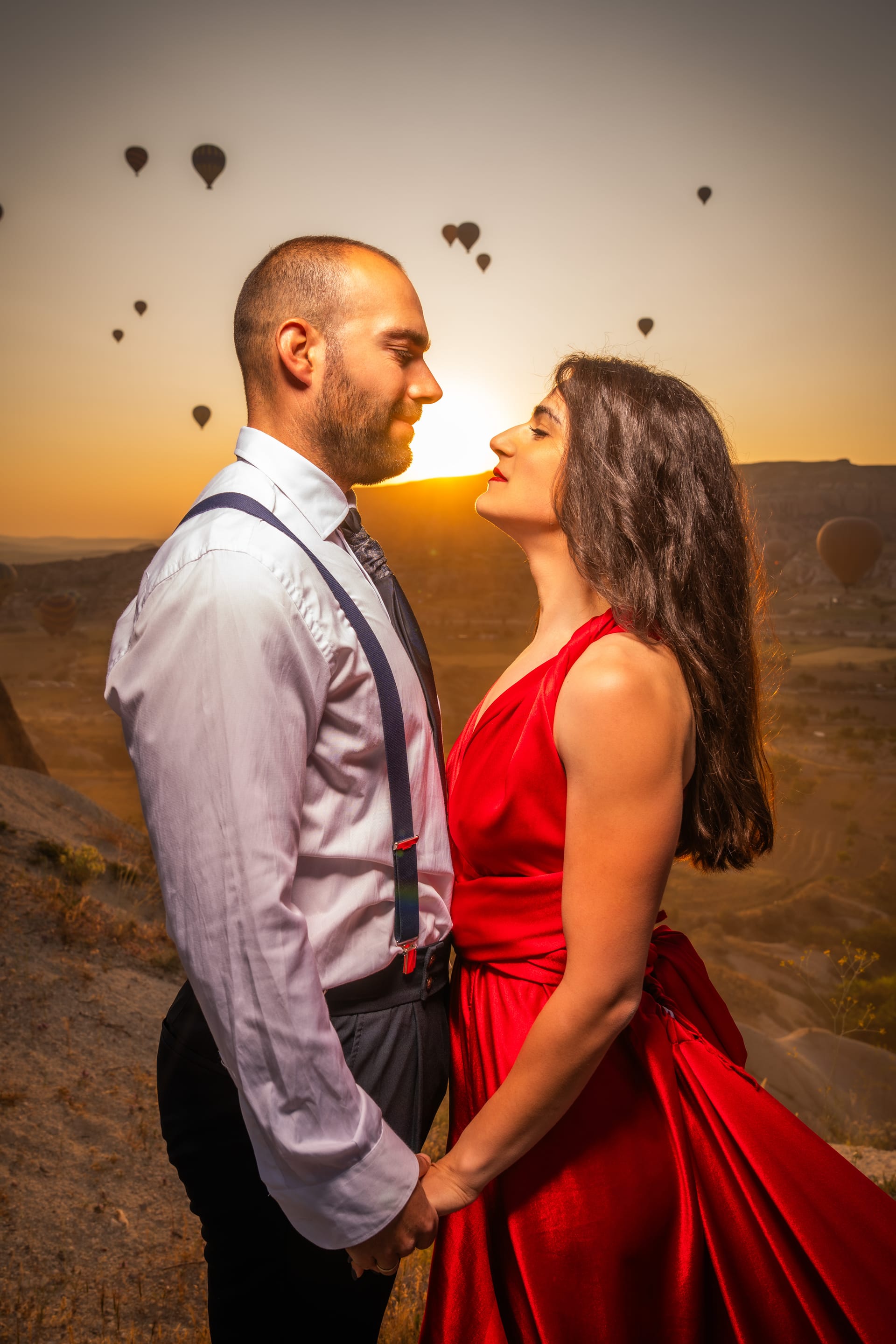
Golden hour — the first hour after sunrise and the last hour before sunset — is photography's most precious window. During this brief period, light turns warm, soft, and directional; shadows lengthen, colors deepen, and everything is coated in a golden filter. Cappadocia's rocky landscape comes alive in this light. But capturing this magical moment requires a preparation process that begins hours in advance.
In this article, we pull back the curtain on a golden hour session — sharing every step from location selection to equipment preparation, light calculations to client coordination.
Before Shoot Day
Location planning: Every golden hour session begins with location selection. We calculate the angle from which the sun will rise or set. This angle changes by season — the summer sun rises farther north, while the winter sun comes from the southeast. The right location ensures the sun strikes from exactly the angle we need.
Using specialized apps, we simulate the sun's movement at a specific location. This way, we know in advance exactly where the sun will be on shoot day, where shadows will fall, and how many minutes the best light will last.
Weather monitoring: The ideal weather conditions for golden hour photography are not a completely clear sky. In fact, a few clouds along the horizon line create far more dramatic colors at sunset. Under a completely cloudless sky, the sunset is fast and flat; clouds scatter and reflect the light, transforming the sky into a painting.
We begin monitoring the weather three days before the shoot. Cloud cover, humidity levels, and wind direction — these three factors determine the quality of the golden hour.
Behind-the-scenes truth: Eighty percent of every golden hour session is preparation. The actual shooting window is only 45-60 minutes, but making those 45 minutes perfect requires hours of planning. Our clients see only the result — and that is how it should be.
Shoot Day: Hour by Hour
Sunset minus 3 hours: Equipment check. Cameras, lenses, reflectors, spare batteries, memory cards — everything is inspected. We also revisit the predetermined location to assess the day's conditions. If the wind direction has shifted or something unexpected has occurred at the location (construction, crowds), we quickly switch to an alternative.
Sunset minus 2 hours: Meeting our clients. Getting acquainted in a relaxed setting, explaining the day's plan, checking outfits and accessories. During this time we read the couple's energy — are they excited, nervous, relaxed? We adjust our approach accordingly.
Sunset minus 1.5 hours: Moving to the location. Arriving early is crucial because we need time for warm-up shots and final adjustments. The first frames are typically portrait-focused — we wait for the light to fully mature before wide-angle landscape shots.
Sunset minus 45 minutes: Golden hour begins. From this point, every minute is valuable. Light changes rapidly and we adapt. Wide-angle, close-up, silhouette, backlight — we transition between different techniques. While guiding our clients from position to position, we stay calm — we never want to create a sense of rush.
Sunset plus 15 minutes: Blue hour. The sky turns deep blue, a final orange line remains on the horizon. This period is very brief but the frames it produces are unique — peaceful, dreamlike, timeless.
Equipment and Technical Details
For golden hour sessions, we typically use two camera bodies — one with a wide-angle lens, the other with a portrait lens attached. This eliminates time lost to lens changes. Reflectors are essential — when the sun is behind subjects, we use a gold reflector to illuminate faces. This prevents the silhouette effect while preserving the beauty of backlighting.
Every one of our experiences is delivered with this level of preparation and professionalism. If you want a golden hour session, explore our packages.
Are golden hour sessions only done at sunset?
No, golden hour also occurs at sunrise. The morning golden hour is generally calmer and less crowded. The sunset golden hour offers warmer colors and a more dramatic sky. Both are excellent.
Is there a golden hour on cloudy days?
Under a completely overcast sky, the classic golden hour light does not form. However, a partly cloudy sky actually creates the most dramatic sunsets. We make the most of the light in all conditions.
How long does golden hour last?
Despite the name, the most intense golden light lasts approximately 30-45 minutes. It varies by season and weather conditions. Winter golden hours are shorter; summer ones can be slightly longer.


Your story begins in Cappadocia
We'll craft something timeless—quiet, elegant, and cinematic.
Explore Experiences